
Mahdia plus El Jem is an oddly perfect pairing. You start with Fatimid gateways and mosques, then you hit the Roman wall of the UNESCO El Jem Amphitheatre. It is the kind of day trip that makes Tunisia feel layered, not repetitive.
I like how the itinerary mixes big-name monuments with smaller, story-driven stops. Two standouts for me are the Skifa El Kahla gate, because it is tangible and still part of the city fabric, and the Mahdia Museum, because you get a clear thread from Libyco-Punic and Roman-African pieces to Byzantine and Islamic legacies.
One thing to plan around: access can change. On at least one similar tour run, multiple sites ended up closed, and the explanation did not feel great. So keep your expectations flexible and ask your guide early in the day what is confirmed on-site.
Key things that make this tour worth your time
- Skifa El Kahla: a 10th-century gate that fed the city’s second line of defense, later rebuilt into the Turkish rampart system
- Mahdia Museum: objects that connect Punic and Roman wreck finds to later Byzantine and Islamic periods
- Old Town walk: a practical 1-hour break on a thin peninsula with sea and medina energy
- Borj El Kebbir (Ottoman fortress): Ottoman military architecture tied to an older Fatimid palace site
- Great Fatimid Mosque: the first Fatimid mosque with a layout partly preserved from the 10th century
- El Jem Amphitheatre: one guided hour in the Roman Coliseum atmosphere, plus the mosaic museum visit after
Mahdia and El Jem, in one focused 8-hour day from Tunis
This is a single-day loop built for momentum. You start at 8:00 am and you’re out for about 8 hours total. That timing is a big deal: it gives you enough daylight for sea views around Mahdia and still leaves time for the main Roman site at El Jem.
You get air-conditioned vehicle comfort with WiFi on board, plus the basics that make a long day easier: private transportation and a tour that is actually structured. The price is $152.69 per person, which is not a budget add-on. But the value case is that key entrances and taxes are included, and the day covers multiple distinct eras without you needing to plan transit and ticket timing yourself.
The “private tour” part matters too. Even though it is not described as a minibus tour, the booking is listed as private for your group, and that usually means you get less waiting around and more ability to move at a pace that fits you. If you are traveling as a duo or a small family, that can make the per-person cost feel more reasonable.
Stacking up Tunis options? Start with these:
- Private Tour to Kairouan, El Jem & Monastir from Tunis_hammamet
★ 5.0 · 301 reviews - Private tour: Medina,Carthage ,Sidi Bou Said, Bardo Museum+lunch
★ 5.0 · 230 reviews - Carthage, Bardo Museum, Sidi Bou Said and Medina Private Day Tour
★ 4.5 · 153 reviews
Skifa El Kahla: the gate you can almost walk through in history
Your first stop is Skifa El Kahla, a huge gate tied to the 10th century. Even if you do not consider yourself a “gate person,” this is a smart start. Why? Because it sets the tone for Mahdia’s defenses, and it does it with something you can physically see.
The site is still an access point into Mahdia’s historic center, sitting inside the old citadel area. It also connects to the later Turkish ramparts rebuilt at the end of the 16th century. In other words, you are not just looking at an isolated monument. You’re looking at a system of defense, where the later walls and entrances build on earlier control points.
What I like: you get about 25 minutes here with admission listed as free in the itinerary, so you can appreciate it without a huge time sink. The drawback is that it is a gate and passage space, not a museum hall. If you’re expecting lots of interior rooms or long explanations, you might want your guide to focus on how the defensive lines worked.
Mahdia Museum: how the region’s layers show up in artifacts
Next is Mahdia Museum, scheduled for 40 minutes with entry included. The museum is a strong “context stop.” It helps you understand what you will see later, especially the mix of cultures tied to the coast.
The ground floor includes objects from Libyco-Punic and Roman-African antiquity. Then you see part of the floor dedicated to Byzantine and Islamic legacies. The museum also highlights Greek influence through two marble columns, described as partly gnawed by mollusks and linked to a Roman wreck off Mahdia. These columns were recovered in the 1940s.
That wreck detail is the kind of thing that makes the coast feel real. You are not just seeing abstract dates. You’re seeing evidence of sea trade and accidents that shaped what survived.
One caution: museum displays move fast in a 40-minute window. If you love reading every label, you might have to choose your priorities. Still, it is a good use of time, especially if you want the rest of the day to make more sense.
Mahdia old town on a thin peninsula: your 1-hour reset
After the museum, you get 1 hour for Mahdia’s Old Town. This is free time in the itinerary, which is exactly what you want after two guided stops. The old town is built along a thin peninsula, and you get a sense of place quickly: medina streets, a working feel, and the sea nearby.
You’ll likely appreciate the views of the sapphire-colored water and the rhythm of a small-town pace, not the tour-bus squeeze. The city is also described as connected to the Fatimid caliphs, since Mahdia was the first capital in the 10th century. Even if you do not chase every historic marker, that connection helps you frame what you see.
Practical tip: use this hour to get oriented and to decide where you want photos. If you can, pick one vantage point where sea meets stone. That way, when your day gets heavier with monumental sites, you still have at least one “breather” view to remember.
Point the Tunis day somewhere else:
- Private Excursion to Testour, Dougga and Bulla Regia from Tunis.
★ 5.0 · 100 reviews - Guided Bike Tour of Carthage Archeological Site in Tunisia
★ 5.0 · 88 reviews - Guided tour in the UNESCO world heritage Medina of Tunis
★ 5.0 · 68 reviews - Group Guided Bike Tour of Carthage Archeological Site in Tunisia
★ 5.0 · 57 reviews
Borj El Kebir: Ottoman fortress architecture with Fatimid echoes
The next stop is the Ottoman fortress Borj El Kebir, also known as a Kasbah. You get about 30 minutes, and admission is included in the tour.
This fortress was erected at the end of the 16th century on the site of an ancient Fatimid palace. That overlap is the key story here. You’re looking at Ottoman military architecture, but the site itself is tied to earlier power.
The description emphasizes a quadrangular plan, later shaped with bastions at the angles. It’s surrounded by a powerful wall, originally pierced with a single entrance. Later, after it shifted to prison use, another access was built in the 19th century. Inside, you get a vaulted and bent passage leading to a courtyard, and then vaulted rooms around it.
My take: this is the kind of stop where photos do not fully capture it. The form of the entrance passage and the shape of the courtyard matter because they show how fortress life was controlled. If you’re sensitive to heat, choose shade when you can, since courtyard time can feel exposed.
Great Fatimid Mosque: a first Fatimid house of prayer, restored after sea reclaimed land
Then you move to the Great Fatimid Mosque, built between 909 and 934 by Obeid Allah el Mehdi. That “first Fatimid” angle makes it historically important, and the architecture details are manageable even in a short visit.
The itinerary notes there is no minaret, and the call is described as coming from one of two towers. Under Spanish occupation, the structure was transformed into a sanctuary. Only part dating from the 10th century is said to be the northern section. Later, there were major restoration efforts starting in 1964, tied to President Bourguiba, on land reclaimed from the sea. That is a lot to process in about 25 minutes, but it also means the mosque is a living record of political change, not a single frozen moment.
What I like is that the core of the plan was redesigned according to the original layout during restoration. So you can still connect what you see to the Fatimid idea of the space, even if other sections reflect later layers.
Practical consideration: religious sites mean you should dress appropriately and be ready for a quieter pace. If you get overexcited with photos, you might want to pause. This is one of those moments where respectful observation pays off.
El Jem Amphitheatre: the Roman Coliseum scale that hits fast
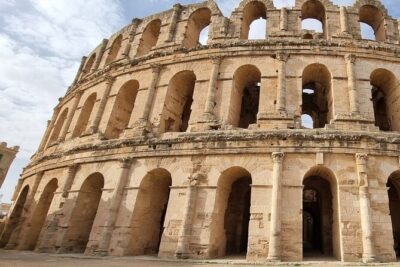
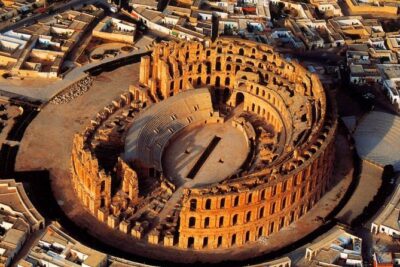
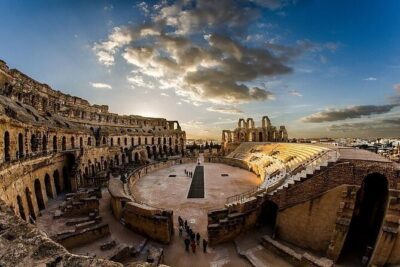
Now for the headline: the Amphitheatre d’El Jem, a UNESCO World Heritage Site. The tour schedules about 1 hour here, with admission included.
This is the Roman Coliseum feeling in a real place, not a museum model. You’ll stand amid imposing walls and see how the architecture was engineered for crowds. It is hard not to picture what the arena held when you look at the preserved structure. Even if you know the basics, the scale still makes your brain do that jump from classroom to street.
The Roman amphitheater story is especially strong because Tunisia has that unique position at crossroads. Here, Roman power is visible in stone, yet the surrounding region keeps telling older and newer stories too. That is why this day works so well: it gives you one dramatic Roman anchor, then lets the earlier Mahdia stops make it feel less random.
Photo tip: try to capture both the exterior mass and your perspective from inside. The amphitheatre reads differently depending on where you stand. And since the stop is guided, you’ll want to listen for the specifics that explain preservation, not just the general “gladiators” hook.
Tythdrus mosaic museum: where you slow down after the arena
After El Jem, the tour includes the archeological mosaic museum of Tythdrus. The schedule does not list a precise time here, but it is clearly set as the next attraction after the amphitheatre visit.
This is a smart choice. After an hour that is all scale and drama, mosaics shift you into detail and craftsmanship. In Roman-influenced contexts like this one, mosaics are often where everyday life and status can become visible through patterns, figures, and materials. Even if you only spend a short window here, it can change how you remember the day.
What to expect: you’re looking for surfaces, patterns, and how scenes were arranged. It can feel more “quiet” than the amphitheatre, which is exactly what you want when your brain has been doing big impressions all morning.
Price and logistics: is $152.69 a fair deal for what you get?
At $152.69 per person, this is priced like an all-in, guided day trip rather than a self-guided route. Whether it feels like a bargain depends on what you would otherwise do on your own.
Here are the value levers that matter:
- Most fees are handled: entry is listed as included for several major stops, and all fees and taxes are covered in the package.
- Transport is private with an air-conditioned vehicle, which is a big deal on hot travel days.
- You get structure: the day moves from Mahdia gates and museums into the Ottoman fortress and Fatimid mosque, then finishes at El Jem.
If you were to replicate the itinerary independently, you would need to coordinate transit between Mahdia and El Jem, solve ticket timing, and build an order that makes sense. That is time and mental energy, and the tour is basically buying you convenience and a guided flow.
One caution based on a reported issue from a similar experience: sometimes sites can be closed. When that happens, the practical question becomes how the guide adapts. The best way to protect yourself is to ask your guide at the start of the day which stops are confirmed and what the backup plan is if something changes.
Who this tour suits best
I’d steer you toward this tour if you want a single-day plan that covers the big eras of Mahdia and gives you the El Jem “wow” factor without stress. It is also a good fit if you travel in a group that values guided explanations more than drifting.
It may be less satisfying if you want maximum time at one monument. The day includes multiple sites, so your time at each is capped. That can be perfect for first-timers, but it is not for people who want to linger for hours in one place.
Since the itinerary says most travelers can participate and that service animals are allowed, it also sounds reasonably welcoming for many visitors.
Should you book this Colosseum of El Jem and Fatimid Mahdia tour?
I think this is a strong choice if your goal is an efficient, guided sampler of Mahdia’s Fatimid and Ottoman sights plus the UNESCO Roman centerpiece of El Jem. The combination of gate, museum, fortress, mosque, and amphitheatre is coherent, and the “included” entries help you feel like you’re not constantly budgeting for tickets.
Just go in with two smart expectations. First, the day is busy, so wear comfortable shoes and plan for a full schedule. Second, access can change, so ask your guide early and stay flexible if a stop is not available.
If that sounds like your travel style, this tour is a solid way to see a lot of Tunisia in one day without losing the plot.
FAQ
What time does the tour start, and how long is it?
The tour starts at 8:00 am and runs for about 8 hours.
Is pickup offered?
Yes, pickup is offered.
Does the tour include admission tickets?
Admission tickets are included for several stops, including the Mahdia Museum, Borj El Kebir, the Great Fatimid Mosque, and the El Jem Amphitheatre. Skifa El Kahla is listed as free in the itinerary.
Is lunch included?
No, lunch is not included.
Will I receive a mobile ticket?
Yes, mobile ticketing is included.
Is this a private tour?
Yes. It is described as private, meaning only your group participates.
What is the cancellation policy?
You can cancel for free up to 24 hours in advance for a full refund. If you cancel less than 24 hours before the start time, the amount paid is not refunded.
Fresh reviews around Tunis
- Private Group Day Tour Tunis Medina Carthage Sidi Bou Said★ 4.5 · 3 reviews
- Explore Tunisia in Depth:The Private Grand Tour in 8 Days★ 5.0 · 3 reviews
- Private Tour Bardo Museum, Carthage, Sidi Bou Said and Medina★ 4.5 · 3 reviews
- 3-Day South of Tunisia Guided Tour from Tunis★ 4.0 · 3 reviews
- Private Tour to Kairouan, El Jem and Sousse★ 5.0 · 4 reviews
- Private Excursion to the Cap Bon Peninsula★ 5.0 · 4 reviews
- From Tunis: Star Wars 5 day tour★ 5.0 · 4 reviews
- 4-Day Private Tour: Sahara and Djerba Island from Tunis and Hammamet★ 5.0 · 4 reviews
El Jem Amphitheatre Tours, compared.

Fun VIP Tour: El Jem, Kairouan, Monastir/Sousse
Read our review →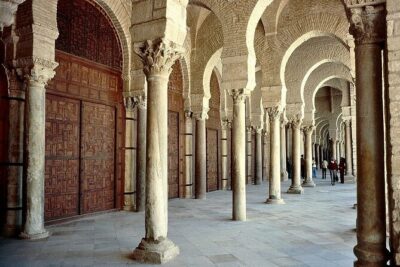
Private Tour to Kairouan, El Jem & Monastir from Tunis
Read our review →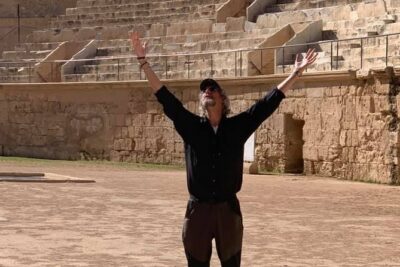
Half-day excursion from Sousse to the amphitheater of El Jem
Read our review →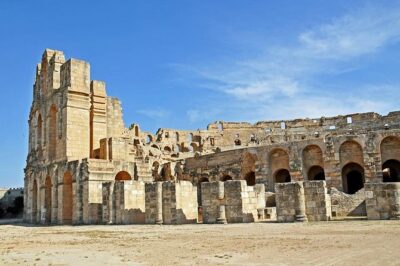
Private and Guided Tour to Kairouan and El Jem and Monastir
Read our review →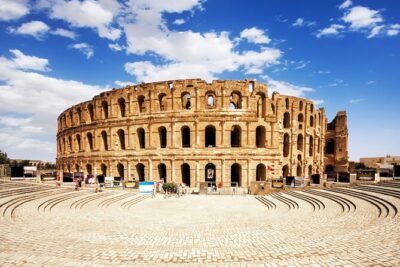
Private Half Day Tour to Roman Coliseum EL JEM from Monastir
Read our review →Browse the lists this tour appears in